Skip to content

The right coating for every side of your home

Low-E Glass Window Installation in Kitchener-Waterloo

GTS Windows & Doors has installed windows with Low-E glass across Kitchener, Waterloo, Cambridge, Guelph and the nearby townships since 1986, in everything from century homes to new subdivisions. We work with homeowners, property managers and builders who want to understand what they are paying for, rather than simply ticking an energy efficient box on an order form. Every installation uses ENERGY STAR certified products and carries our 20-year parts and labour warranty.

Low-E, short for low emissivity, is a microscopically thin coating of metal and metal oxide layers applied to one surface of the glass. It is invisible in normal light, yet it does more to cut heat loss through a modern window than any other single feature, including the gas fill. Almost every ENERGY STAR window sold in Canada today has at least one Low-E coating, but the type of coating and the glass surface it sits on vary a great deal between products.

Not all Low-E coatings behave the same way, and that is the part most window quotes skip. Some coatings let the low winter sun warm your living room, while others block solar heat to stop west-facing bedrooms and home offices overheating on summer afternoons. We choose coatings by orientation and by room, so each side of your house gets glass that suits its sun exposure, its shading and how the space is used.

What Low-E Glass Does

Every warm object gives off long-wave infrared heat, including your walls, furniture and the people in the room. Plain glass absorbs that heat and passes it outdoors, while a Low-E coating reflects much of it back inside.

The coating also filters incoming sunlight. It passes most visible light while reflecting a chosen share of short-wave solar heat and ultraviolet light, and that share depends on the coating.

The result is warmer glass in winter, cooler rooms in summer and slower fading. Compared with clear double pane glass, one Low-E coating plus argon roughly halves heat loss through the centre of the glass.

Types of Low-E Coatings

Glass makers sell soft-coat Low-E in families that range from high solar gain to strong solar control. The comparison table uses three widely available products from one major maker as examples, with approximate centre-of-glass values in a double pane argon unit.

Hard-Coat vs Soft-Coat Low-E

Hard-coat, or pyrolytic, Low-E is fused into the glass surface while the glass is still hot at the float plant. It is durable enough to face a room or even the outdoors, but it insulates less well.

Soft-coat, or sputtered, Low-E is applied in a vacuum chamber as ultra-thin layers of silver. It performs much better but must be sealed inside the insulating unit, and it is what most ENERGY STAR windows use today.

Some high-performance units add a hard-coat on the room-side surface to push the U-factor lower still. The trade-off is a colder inner pane, so condensation appears sooner in humid homes, and we only suggest it where indoor humidity is well controlled.
Coating Position and Solar Heat Gain

Glass surfaces are numbered from the outside in, so a double pane unit has surfaces 1 to 4. A coating on surface 2 blocks more solar heat before it reaches the cavity, while a coating on surface 3 admits more solar heat yet still reflects room heat back inside.

The number that captures this is the solar heat gain coefficient, or SHGC, on a scale of 0 to 1. Higher values let in more free solar heat, and lower values keep rooms cooler.

Coating typeExample productApprox. SHGCApprox. UV blocked
Single silver, high solar gainCardinal LoE-1800.6971 percent
Double silver, moderate gainCardinal LoE²-2720.4085 percent
Triple silver, solar controlCardinal LoE³-3660.2795 percent

Choosing Low-E by Window Orientation

In a heating climate like Waterloo Region, the sun is a free heater in winter and a nuisance in summer. The trick is matching the coating to the wall, whichever window style and frame you choose.

  • Mixing coatings on one house is normal and usually adds little cost, since it is a glass specification rather than a different window.
  • Coatings differ slightly in tint and reflection, so we compare samples before mixing them on the same side of the house.
  • Shade from trees, porches and neighbouring houses changes the picture, so we assess each window on site rather than going by compass direction alone.

South-Facing

Low winter sun reaches deep into south rooms, while eaves partly shade the high summer sun. A high or moderate solar gain coating captures that free heat, and this is the wall where strong solar control glass costs you most.

West-Facing

Low afternoon sun in July and August strikes west glass almost head-on, and eaves do little to stop it. A low-SHGC solar control coating keeps west bedrooms, kitchens and home offices from overheating.

North-Facing

North glass sees almost no direct sun, so solar gain barely matters. Put your money into the lowest U-factor you can afford, which is where a triple pane window earns its place.

East-Facing

Morning sun is gentler and warms rooms when they are coolest. A moderate coating suits most east elevations, with solar control reserved for large east glass that overheats.

Low-E and Protection From Fading

Ultraviolet light is the main driver of fading, but visible light and solar heat play a part too. That is why no glass can promise zero fading, even with excellent UV blocking.

Low-E coatings vary widely in UV protection, from roughly 70 percent blocked for a high-gain coating to 95 percent for a triple-silver product. For hardwood floors, artwork or antiques in bright south and west rooms, the solar control end of the range pays off.

Where fading is the top concern, laminated glass adds near-total UV blocking. Blinds and sheers still help on the sunniest walls.

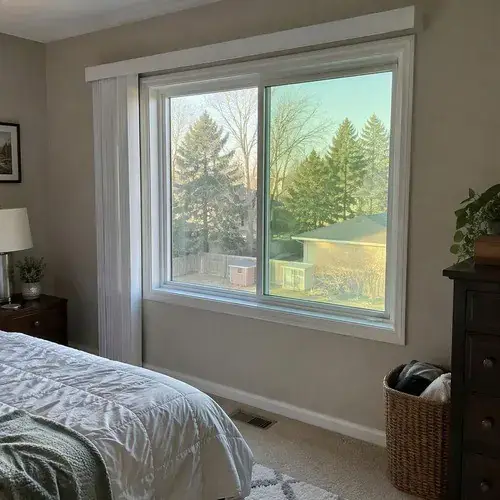
White sliding window with two panes in a bedroom wall

How to Tell If Your Glass Has Low-E

Many homeowners are unsure whether their existing windows have a coating at all. These checks answer the question without taking anything apart.

  • Reflection test: at night, hold a lighter flame or phone flashlight near the glass and look at the reflections. Double pane glass shows four, and one reflection in a different colour, often faintly purple, green or orange, marks a coated surface.
  • Low-E detector: glass shops use inexpensive handheld meters that touch the glass and show which surface is coated.
  • Spacer bar: many sealed units have the maker, date and sometimes the glass type printed or stamped on the spacer between the panes.
  • Label and paperwork: new windows arrive with a label showing U-factor, ER and often SHGC, so photograph it before peeling it off.
  • Tint: coated glass can look very slightly tinted compared with clear glass, although this is not reliable on its own.
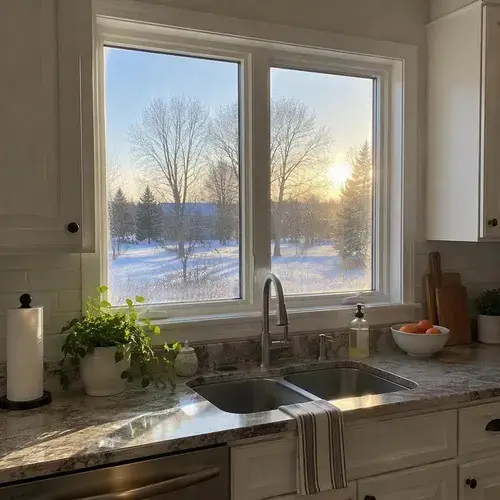
White double-pane kitchen window over a sink at sunset

Pairing Low-E With Argon and Warm-Edge Spacers

A Low-E coating cuts radiant heat transfer across the cavity, argon slows conduction and convection in the same space, and a warm-edge spacer tackles the cold perimeter. Each one handles a different path for heat, which is why the three are specified together.

Low-E without a gas fill leaves performance on the table, and argon without Low-E adds little. Our page on insulated, energy efficient windows shows how the full glass package and frame combine, and how to read the resulting ratings.

If your current windows have no coating at all, new glass will be a noticeable upgrade. Our guide on when to replace windows covers the other signs worth checking first.

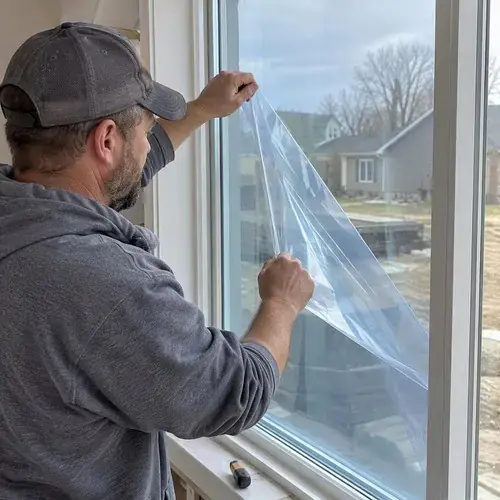
Man in cap peeling clear protective film off the glass of a new white

Low-E Glass FAQs

Does Low-E glass make rooms darker?

Barely, with standard coatings. High-gain and moderate Low-E coatings pass most visible light, while strong solar control coatings reduce it more and can look slightly tinted. The visible transmittance, or VT, figure on the specification sheet tells you how much daylight a glass package lets through.

Can Low-E be added to my existing windows?

Not as a factory coating, since it is applied when the glass is made. If your frames are sound, the sealed unit can be replaced with a new Low-E unit, or a Low-E window film can be applied to the room-side glass. Our window film and tinting page explains film options and their limits.

Do ENERGY STAR windows need Low-E glass?

NRCan's current specification, Version 5.0, sets performance targets of a U-factor of 1.22 or lower, or an ER of 34 or higher, rather than naming Low-E. In practice, double and triple pane windows almost always need at least one Low-E coating to reach those numbers. So while it is not written as a rule, nearly every certified window has it.

Does Low-E glass affect cell phone signal?

It can. The metal layers that reflect heat also reflect radio signals, and strong multi-layer coatings can noticeably weaken indoor cell reception, especially in homes already at the edge of coverage. Wi-Fi calling or an approved signal booster usually solves it, and it is worth mentioning before you choose solar control glass for every window.

Choose the Right Low-E Glass

We will look at which way each window faces and recommend a coating for every elevation. Your quote lists the glass specification for each opening.

Call or text226-806-0597
Monday to Saturday: 7:00am to 9:00pm
Sunday: 9:00am to 5:00pm
47 Bridge Street East, Kitchener, ON N2K 1J7
Call 226-806-0597Quote